
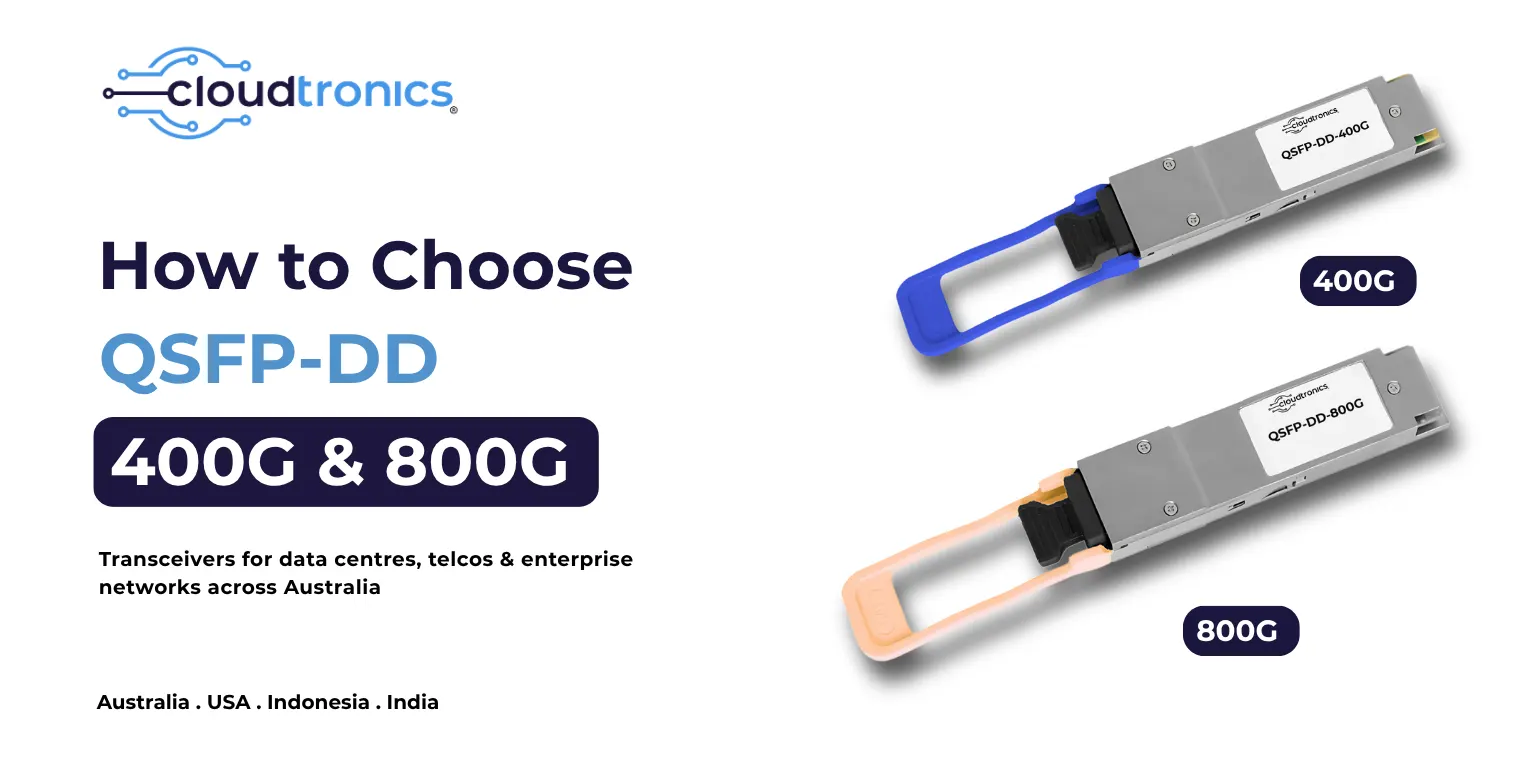
Quick answer: 400G and 800G QSFP-DD transceivers are the pluggable optical modules that carry 400 or 800 gigabits per second between switches, routers, servers and sites. They are used in data centres, telecommunications and ISP backbones, enterprise cores and research networks. Choose one in this order: match your switch port (QSFP-DD, QSFP-DD800 or OSFP), then the distance (SR, DR, FR, LR or ZR), the fibre and connector, the breakout plan, the power budget and the vendor coding. In Australia, Cloudtronics supplies and codes 400G and 800G optics with local support from Sydney and Melbourne.
Why 400G and 800G modules matter
For years, 10G and then 100G did the heavy lifting in most Australian networks. Traffic hasn’t stopped growing, though. Cloud apps, video streaming, 5G, remote work, backups and, more recently, AI workloads all push more data through the same racks and fibre. When 100G ports fill up, you have two choices: add more switches and fibre, or make each port faster. 400G and 800G optics let you do the second.
- More bandwidth per port: one 400G port carries what four 100G ports do, and one 800G port replaces eight.
- Lower cost and power per bit: fewer switches, fewer cables and less power for the same capacity.
- Less space: QSFP-DD keeps the same port density as QSFP28, so a 1RU switch can carry up to 14.4 Tb/s at 400G and roughly double that at 800G.
- Flexible breakout: one fast port can split into several 100G or 400G links, so you can upgrade the core first and the edge later.
- Future-ready: 800G Ethernet is a ratified IEEE standard, and the next step (1.6T) is on the way. Buying into QSFP-DD keeps your upgrade path open.
You don’t need an AI supercomputer to benefit. Any network that’s outgrowing 100G is a candidate. We cover the main use cases further down, from AI and data centres through to telcos, enterprise and research.
What is a QSFP-DD transceiver?
QSFP-DD stands for Quad Small Form-factor Pluggable Double Density. It looks almost exactly like the QSFP28 module you’d use for 100G, but it has a second row of electrical contacts. That doubles the lanes from four to eight.
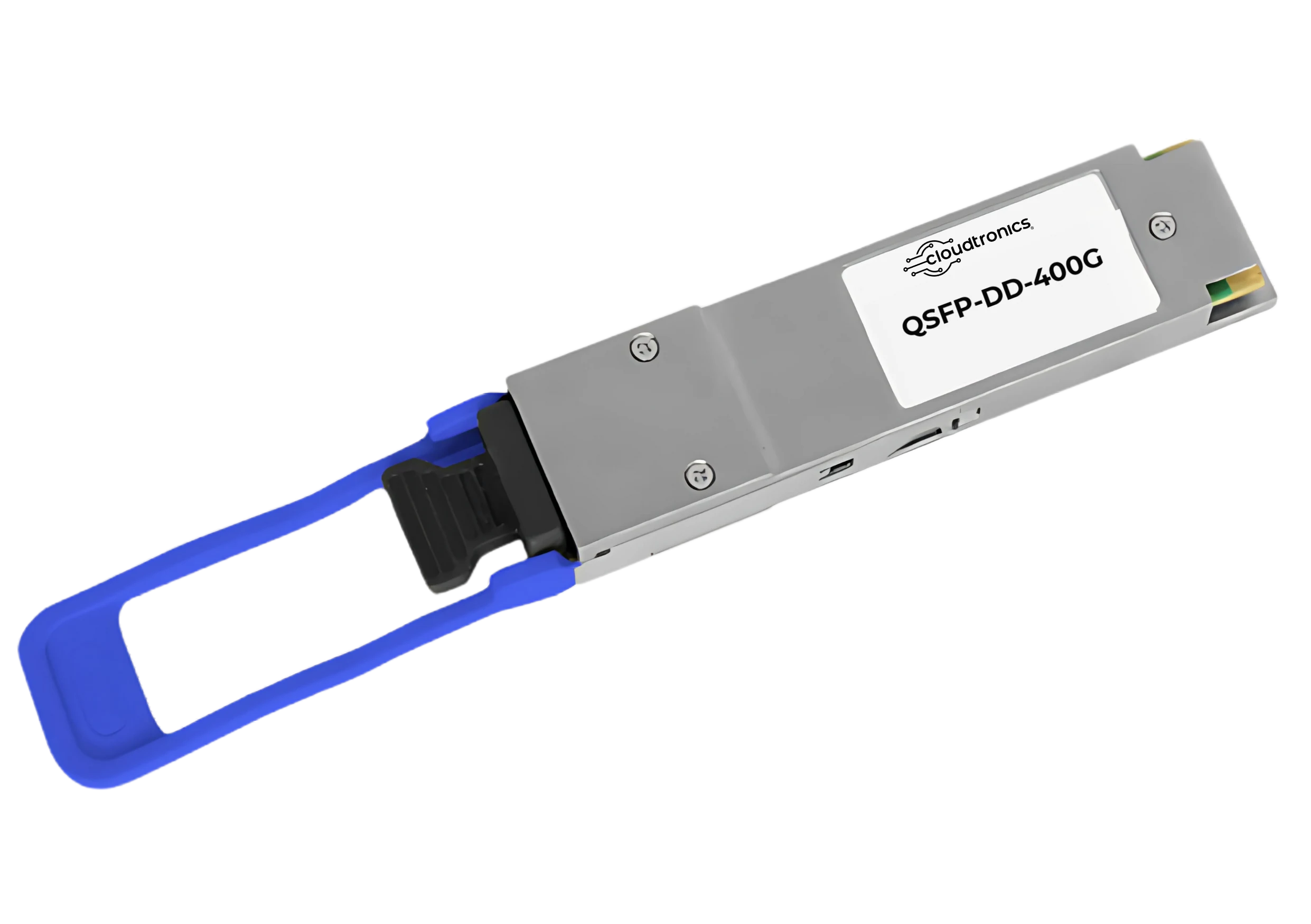
400G QSFP-DD:
8 lanes × 50 Gb/s (PAM4) = 400 Gb/s
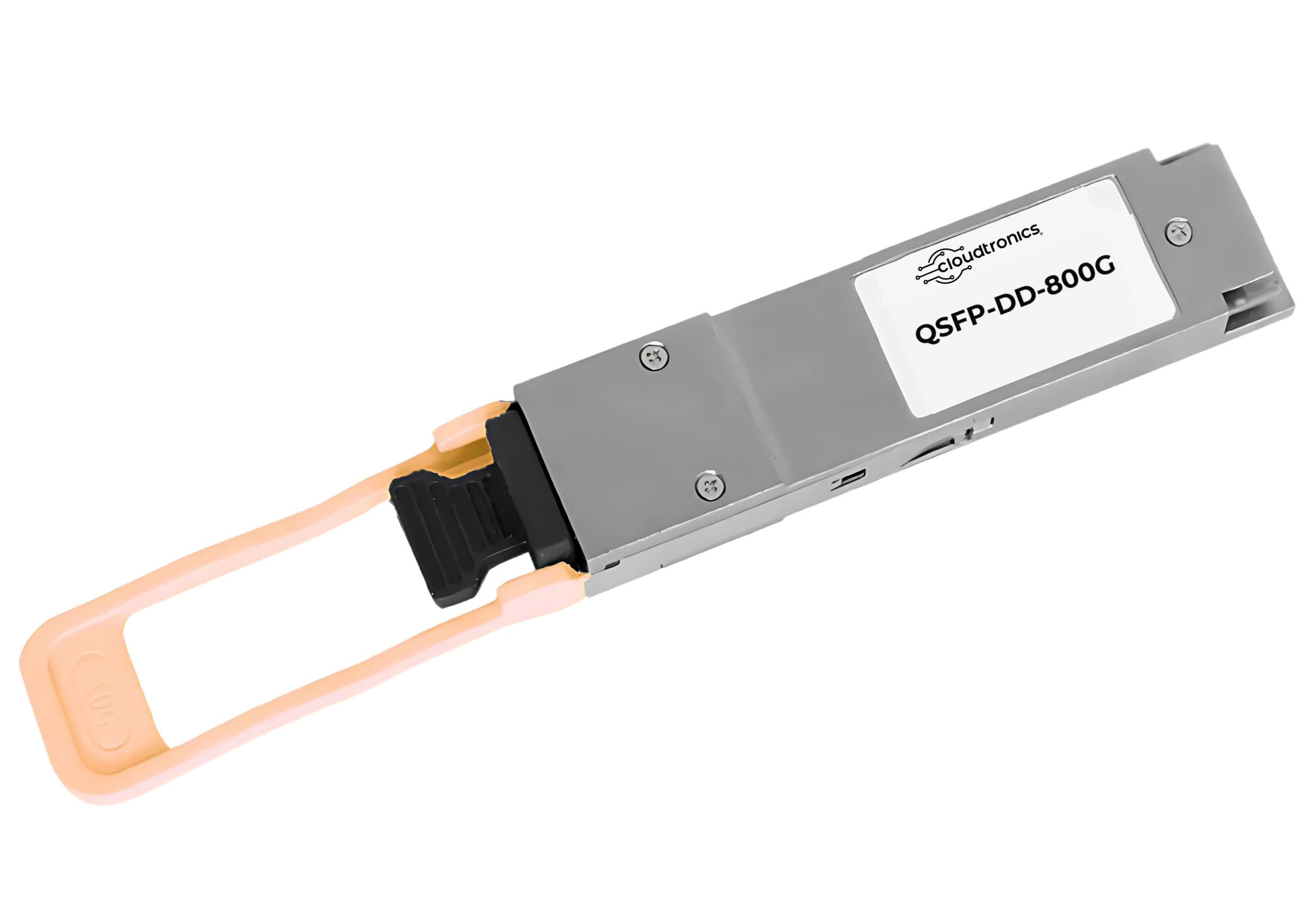
800G QSFP-DD800:
8 lanes × 100 Gb/s (PAM4) = 800 Gb/s
New to transceivers? Start with our guide to types of SFP transceivers, then come back here.
400G vs 800G: which one do you actually need?
Faster isn’t always better value. Here’s a simple way to decide:
| Question | Go 400G QSFP-DD if… | Go 800G if… |
|---|---|---|
| What switch do you have? | You run 12.8T or 25.6T switches with 400G ports | You're installing 51.2T-class switches with 800G ports |
| What's the workload? | Enterprise core, cloud, storage, ISP aggregation | AI/GPU training clusters, hyperscale spine |
| Server NIC speed? | 100G–200G per server | 400G+ per GPU |
| Breakout needs? | 1×400G or 4×100G | 2×400G or 8×100G per port |
| Budget priority? | Lowest cost per port today | Lowest cost per bit and fewer ports |
| Typical module power | ~8–12 W (DR4/FR4) | ~13–18 W |
Plenty of Aussie sites run both: 400G for the existing core and 800G for the new AI pod. If you’re still mostly on 100G, see our 100G QSFP28 module guide. Those modules will keep working in your new QSFP-DD ports.
QSFP-DD vs OSFP: does the form factor matter?
Yes. It’s the first thing to check. At 800G you’ll see two main form factors:
- QSFP-DD800: compact and backward compatible with QSFP28 and 400G QSFP-DD. Popular on Ethernet switches where you want to reuse existing optics.
- OSFP: slightly bigger, with more room for heat and power. Common on GPU-centric platforms and InfiniBand fabrics.
The two are not interchangeable. An OSFP module won’t fit a QSFP-DD cage, and the reverse is also true. Match what’s on the switch or NIC. For a deeper dive into the two packages, read our article on 800G optical modules.
400G and 800G module types and reach
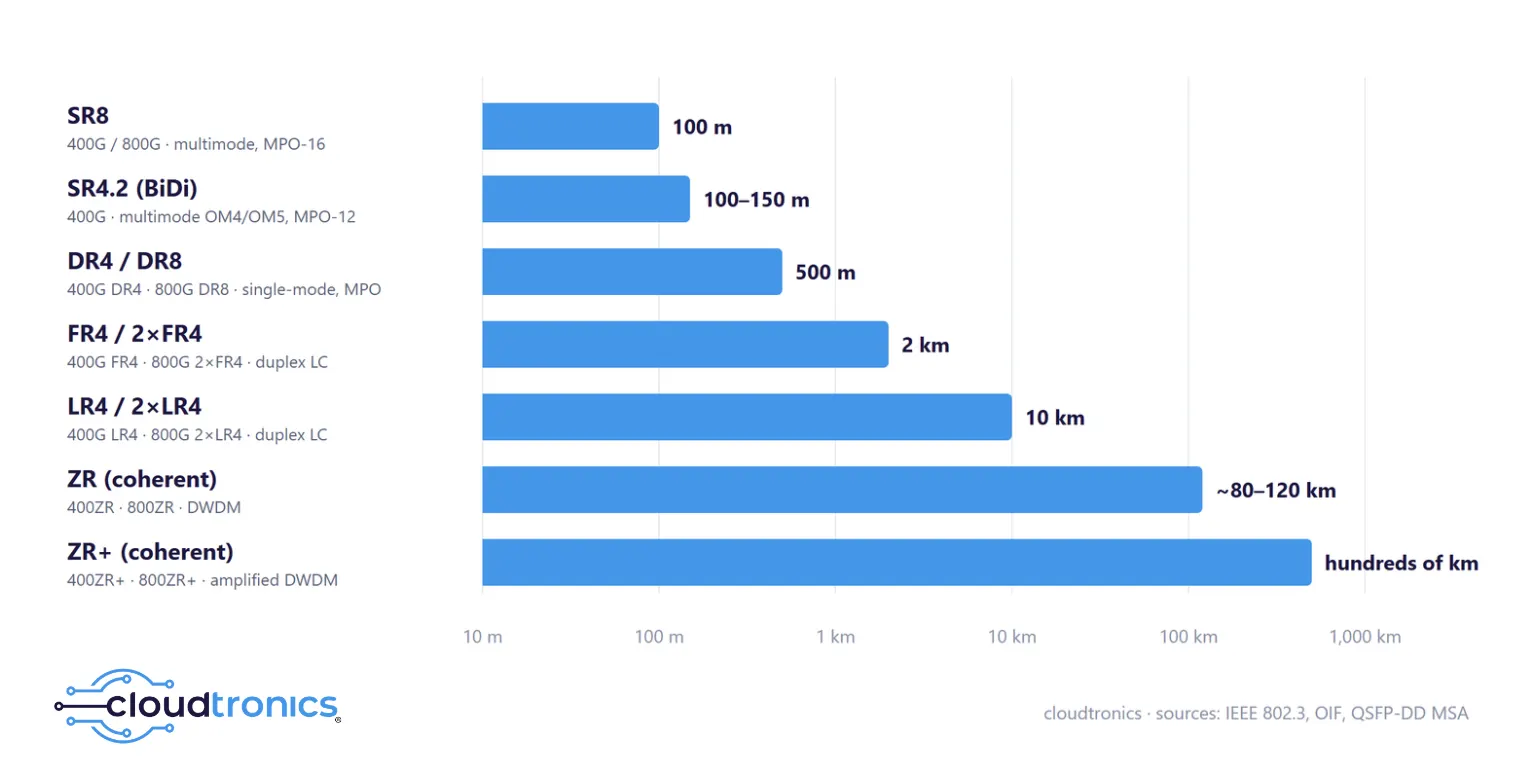
Distance is the biggest factor in picking a module. The good news is that 400G and 800G share the same “reach classes”, so once you know the distance the choice is easy.
| Module type | Typical reach | Fibre | Connector | Best for |
|---|---|---|---|---|
| 400G SR8 / 800G SR8 | Up to 100 m (OM4) | Multimode | MPO-16 | In-row server-to-leaf links |
| 400G SR4.2 (BiDi) | 100–150 m (OM4/OM5) | Multimode | MPO-12 | Reusing existing multimode trunks |
| 400G DR4 / 800G DR8 | 500 m | Single-mode | MPO-12 / MPO-16 | Leaf-to-spine, 100G/400G breakout |
| 400G FR4 / 800G 2×FR4 | 2 km | Single-mode | Duplex LC / dual LC | Across the hall or campus |
| 400G LR4 / 800G 2×LR4 | 10 km | Single-mode | Duplex LC / dual LC | Building-to-building |
| 400ZR / 800ZR | ~80–120 km | Single-mode DWDM | Duplex LC | Data centre interconnect (DCI) |
| ZR+ (coherent) | Hundreds of km | Amplified DWDM | Duplex LC | Metro and regional backbone |
How to choose a 400G or 800G QSFP-DD module in 6 steps
Where 400G and 800G modules are used in Australia
400G and 800G optics turn up anywhere a network has outgrown 100G. These are the most common use cases we see.
1. The rise of AI and data centres
AI is the fastest-growing use case right now. GPU clusters move huge amounts of data between servers, and every GPU needs a fast, low-latency path to the others. At that scale 100G becomes the bottleneck, so new AI halls are built on 400G and 800G from day one. The wider data centre boom is adding to the demand.
2. Telcos, ISPs and 5G backhaul
Carriers and regional ISPs use 400G in their core and aggregation layers as mobile and fixed broadband traffic keeps climbing. 400G LR4 covers links up to 10 km, and coherent 400ZR/ZR+ plugs straight into routers for longer runs.
3. Data centre interconnect (DCI)
400ZR and 800ZR coherent modules link sites across a metro area, for example between Sydney’s western suburbs and the CBD, without a separate optical shelf.
4. Enterprise and campus core
Large enterprises, banks, hospitals and councils are moving their core and storage networks to 400G to cope with cloud, backup and video traffic. Breakout lets one 400G port feed four 100G switches.
5. Universities, research and government
HPC clusters, research networks and secure government sites need high-bandwidth links. Some also have supply chain rules. See our article on TAA-compliant transceivers.
6. Broadcast, media and live events
Uncompressed 4K/8K video and remote production move huge streams between studios, stadiums and playout centres. 400G links keep those workflows running smoothly.
From 100m to 120km+
How Cloudtronics supports Australian 400G and 800G projects
Cloudtronics is an Australian network solutions company headquartered in Brookvale, NSW, with an office in Cranbourne West, VIC. We help data centres, carriers, ISPs, MSPs, enterprises and research teams get high-speed optics that just work.
- 400G and 800G supply: QSFP-DD and QSFP-DD800 modules across SR8, DR4/DR8, FR4/2×FR4, LR4 and ZR, plus OSFP when your platform needs it.
- Coded for your switch: compatible coding for the major switch and router brands, backed by our programmable transceivers range and coding lab.
- Local help: a team in Sydney and Melbourne on Australian time, with no overseas ticket queues.
- Bulk and project supply: staged deliveries for large data centre, carrier and AI roll-outs. See our bulk supply guide.
- Everything around the optics: passive CWDM/DWDM components, ConsoleMate console servers for out-of-band access, and MAXIMATE remote transceiver support.
Comparing suppliers? Here’s how we stack up as an FS.com alternative in Australia.
Planning a 400G or 800G upgrade?
Tell us your switch model, link distances and quantities. We’ll come back with the right modules, coding and a quote.